care@sarvjagat.com - GST NO. : 24RCCPS5344N1ZS
- Send Email


| Business Type | Manufacturer, Exporter, Supplier |
| Compressor Type | Heavy Duty Twin Head Piston Type |
| Phase | Three Phase |
| Frequency | 50 Hz |
| Click to view more | |
Product Details
Motor Power
40 HP / 30 KW
Manufacturer
Sarv Jagat Corporation
Model Name
SJ PD 40
Working Pressure Range
12 BAR To 35 BAR
Air Delivery Capacity
70-100 CFM
Compressor Configuration
Duplex
Receiver Tank Capacity
500-750 Liters
Voltage Requirement
415 V AC
Cooling Type
Air Cooled
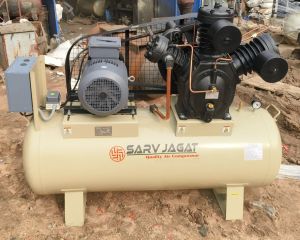
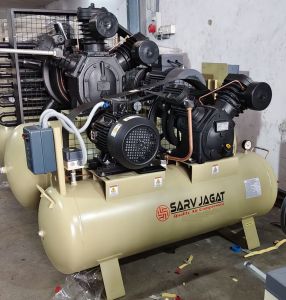
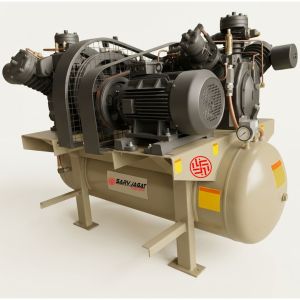
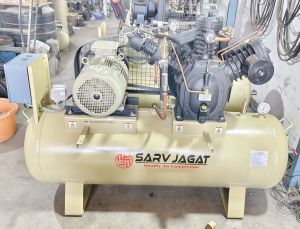
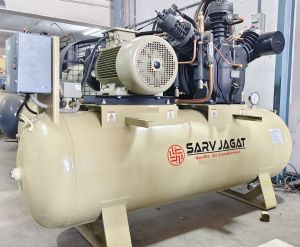
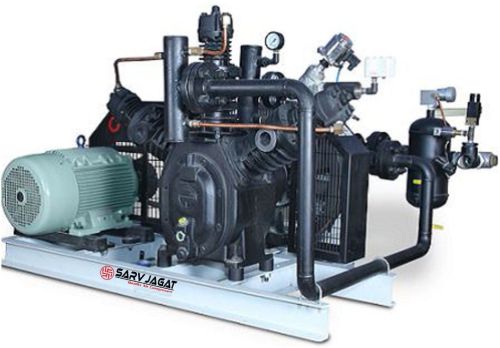
SJ PB 40 Reciprocating Booster Air Compressor 40 HP High Pressure 15–40 Bar Industrial Booster System
The SJ PB 40 is a reciprocating booster air compressor designed to increase existing compressed air pressure from standard plant levels to high-pressure requirements for specialized industrial applications. This system is not a primary compressor; it is engineered to take pre-compressed air (typically 7–13 bar) and boost it to higher pressure levels up to 40 bar.
This makes it a critical component in industries where standard compressors cannot meet pressure requirements, especially in PET blowing, high-pressure testing, and process applications.
Technical Specifications (Strictly from Sheet)
-
Model: SJ PB 40
-
Type: Reciprocating Booster Air Compressor
-
Power: 40 HP / 30 kW
-
Minimum Delivery Pressure: 15 Bar (218 PSI)
-
Maximum Delivery Pressure: 40 Bar (580 PSI)
-
Suction Capacity:
-
200 CFM @ 7 Bar inlet
-
275 CFM @ 10 Bar inlet
-
350 CFM @ 13 Bar inlet
-
Working Principle and System Role
The SJ PB 40 operates as a secondary compression stage (booster):
-
Air is first generated by a primary compressor (screw or piston)
-
This air enters the booster at medium pressure (7–13 bar)
-
Booster compresses it further to high pressure (up to 40 bar)
Engineering Purpose of Booster Compressor
-
Standard compressors efficiently operate up to 7–13 bar
-
High-pressure applications (25–40 bar) require staged compression Booster systems are used because:
-
Direct compression to high pressure is inefficient
-
Multi-stage compression improves energy efficiency
-
Booster allows use of existing compressor system
Industry Applications and Machine-Level Usage (SEO Focus)
1. PET Bottle Blowing Industry (Primary Application)
Used in:
-
Packaged drinking water plants
-
Soft drink and beverage industries
-
FMCG packaging plants
Machines:
-
PET stretch blow molding machines
Process:
-
Pre-compressed air (7–13 bar) → booster → 30–40 bar
-
High-pressure air used for final bottle shaping
Why booster:
-
Required pressure for PET blowing: 30–40 bar
-
Booster provides final stage compression efficiently
2. Industrial Pressure Testing Systems
Used in:
-
Pipeline pressure testing
-
Vessel and tank testing
-
Valve testing systems
Machines:
-
Hydro-pneumatic test rigs
-
Pressure calibration systems
Why booster:
-
Testing requires high pressure beyond standard compressors
-
Booster ensures controlled pressure increase
3. Plastic and Polymer Processing Industry
Used in:
-
PET and plastic container manufacturing
-
Blow molding systems
Machines:
-
Blow molding machines
-
Injection blow systems
Why:
-
High-pressure air required for shaping and forming processes
4. Oil & Gas and Energy Sector
Used in:
-
Pipeline pressure testing
-
Leak detection systems
-
Gas system validation
Machines:
-
Pressure testing units
-
Pipeline maintenance systems
Why:
-
High-pressure air required for safety and integrity testing
5. Industrial Gas Handling and Air Boosting
Used for:
-
Air boosting applications
-
Pre-compression for storage systems
-
Gas compression (limited scale)
Why:
-
Existing system pressure insufficient
-
Booster increases pressure without replacing main compressor
6. Heavy Engineering and Manufacturing
Used in:
-
High-pressure pneumatic systems
-
Specialized industrial tools
-
Controlled pressure applications
Industries:
-
automotive
-
heavy fabrication
-
machinery manufacturing
7. Industrial Cleaning and Surface Preparation
Used in:
-
High-pressure air cleaning systems
-
Surface preparation processes
Why:
-
Higher pressure improves cleaning efficiency
-
Used in heavy industrial environments
Why Booster Compressor is Used
Compared to Direct High-Pressure Compressor
-
Lower capital cost (uses existing compressor)
-
More energy-efficient multi-stage compression
-
Flexible system design
Compared to Standard Compressor
-
Standard compressors limited to ~13 bar
-
Booster required for 25–40 bar applications
Application Suitability
Best suited for:
-
PET bottle blowing systems
-
High-pressure testing applications
-
Air boosting in existing compressed air systems
-
Industrial processes requiring 25–40 bar air
Not suitable for:
-
General workshop air
-
Low-pressure applications
-
Standalone air generation (requires primary compressor)
System Configuration Requirement
To operate SJ PB 40 effectively:
-
Primary compressor (7–13 bar supply)
-
Air receiver before booster
-
Aftercooler and moisture separator
-
High-pressure storage tank
-
Safety valves and pressure control system
Operational Considerations
-
Requires stable inlet pressure for efficient operation
-
High-pressure systems require proper safety controls
-
Maintenance required for piston components
-
Heat generation higher due to high compression ratio
Market Positioning
The SJ PB 40 is positioned as:
-
A high-pressure booster system for industrial processes
-
A critical component in PET and testing industries
-
A cost-effective solution for upgrading pressure without replacing compressors
Core Selection Logic
-
Need 7–13 bar → Screw or piston compressor
-
Need 25–40 bar → Booster system required
-
Already have compressor → Add booster (SJ PB 40)
Critical Engineering Insight
Booster compressors are selected when:
-
Existing compressor capacity is sufficient in CFM
-
Only pressure needs to be increased
-
Process requires staged compression
Practical Selection Guidance
Choose SJ PB 40 when:
-
You already have a compressor system
-
Your process requires higher pressure than available
-
Replacing entire system is not economical
Looking for "40 HP Reciprocating Booster Air Compressor" ?
piece